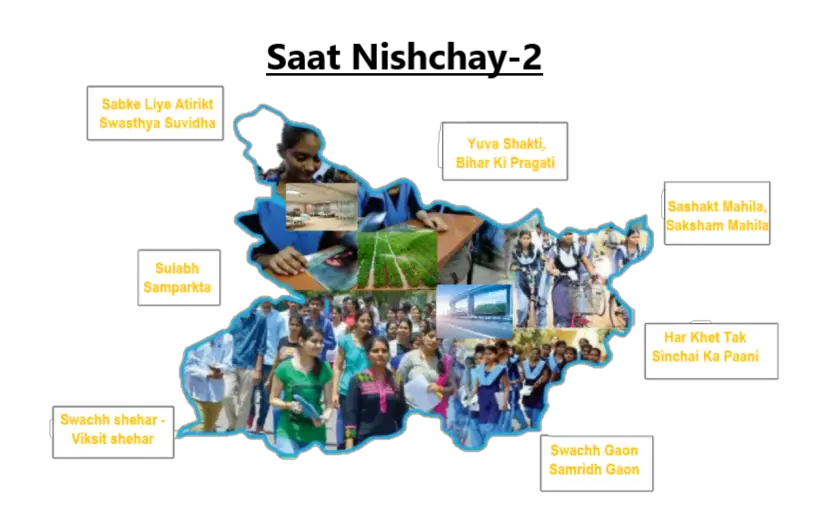
■ Bihar government’s commitment to the principle of “Development with Justice“, the program of good governance will be implemented across the state under the Aatmanirbhar Bihar-Saat Nishchay-2 (2020-2025) scheme.
Objective:
To improve the lives of the people and plan for the State’s development and make it self-reliant.
Theme:
Saksham Bihar – Self-reliant Bihar
Launch:
Saat Nishchay-2 was launched on 15th December 2020.
Implementation:
To ensure the implementation, Bihar Vikas Mission will oversee and monitor these programs. At the district level, the District Program Implementation Committee, chaired by the responsible minister for monitoring, will oversee the implementation of these programs.
In the Bihar Budget 2025-26, under the Saat Nishchay-2 of Aatmnirbhar Bihar (2020-25), ₹5,972 crore has been budgeted for various departments for the FY 2025-26.
Following are the seven ‘nishchay’ for a developed Bihar made under the Saat Nischay-2 of Aatmanirbhar Bihar (2020-25):

(1). Yuva Shakti, Bihar Ki Pragati (Youth power – progress of Bihar):
Under this nishchay, several programs have been implemented in Bihar for the youths, these include:
• Bihar Student Credit Card Scheme for higher education, the Self-Help Allowance Scheme to help youth find employment, and programs such as Kushal Yuva (Skilled Youth) to provide training in computer, communication, and behavioural skills. All of these programs will continue in the future.
Additionally, arrangements for better technical training will be made for youth so that they can get better employment opportunities. At the same time, entrepreneurship will be promoted in Bihar, so that young people can become entrepreneurs themselves and provide employment opportunities for others.
• Plan to improve the quality of institutions:
Over the past five years, several institutions have been established at the district and sub-divisional levels. Now, in order to improve the quality of training at every ITI and polytechnic institution in the state, a high-level Centre of Excellence will be established. Children studying in ITI and polytechnic institutions will be trained in high-tech and new areas such as solar drone technology, optical fibre and networking, transformer maintenance, and others, which have high market demand.
• Mega Skill Centres (Guidance, Training in New Skills) in every district:
In each district, at least one Mega Skill Center will be pened for youth who are not studying in ITI and Polytechnics and want to receive training in new skills. Popular and useful skills such as apparel making, refrigeration, air conditioning, solar panel mechanics, beauty andwellness training, and care-giving for the elderly and patients will be provided with short-term employment-oriented training, which is in demand in the market.
• Tool Rooms (in every division):
Tool rooms and training centres will be established in every division. Many new and modern machines from various fields are available in the tool room. Young people who have received training from ITI and Polytechnics will be given training on these modern machines. There will also be provisions for long-term training for 10th and 12th pass young
people. After receiving this training, youth will have the opportunity to find employment in high-tech fields.
• New Department for Skill and Entrepreneurship (including ITI/Polytechnic):
A separate department will be established to give special emphasis on skill development and entrepreneurship. Skill development and entrepreneurship will be given special attention in this department.
• Technical education in Hindi:
Efforts will be made under the central government’s scheme to make technical education available in Hindi.
• Establishment of new Medical, Engineering and Sports Universities:
To strengthen medical education and engineering education in Bihar, a medical university and an engineering university will be established. Additionally, a sports university will be established in the Rajgir Sports Academy complex to promote sports in Bihar.
• Promote entrepreneurship:
To promote entrepreneurship, not only high-level training arrangements are being made for the youth, but the government will also help them start their own enterprise/business. An amount of up to 50% of the project cost, maximum of ₹5 lakh will be given as a grant for a new venture or business, and a loan of up to ₹5 lakh will be given at a 1% interest rate.
(2). Sashakt Mahila, Saksham Mahila (Strong women, capable women):
• Scheme for Women Entrepreneurship:
To promote entrepreneurship among women, the Bihar government have launched Mukhyamantri Mahila Udyami Yojana (MMUY). Under this scheme, 50% of the project cost, with a maximum grant of ₹5 lakhs, and interest-free loans up to a maximum of ₹5 lakhs is provided.
• Encourage women for higher education:
To encourage women for higher education, financial assistance of ₹25,000 is given under Mukhyamantri Balika (Intermediate) Protsahan Yojana and ₹50,000 is given under Mukhyamantri Balika (Snatak) Protsahan Yojana.
(Read the scheme details in MKUY)
• Participation of Women in Regional Administration according to Reservation:
The participation of women in regional administration, such as in police stations, blocks, subdivisions, and district-level offices, will be increased in accordance with reservation.
(3). Har Khet Tak Sinchai Ka Paani (Water for Irrigation to Every Field):
Water for irrigation will be made available to every field through every possible means.
(4). Swachh Gaon Samridh Gaon (Clean Village – Prosperous Village):
• Solar street lights in all villages:
Solar streetlights will be installed in all villages. Regular maintenance will also be ensured.
• Solid and liquid waste management:
Solid and liquid waste management and sanitation arrangements will be made in the villages. Drains and alleys will be cleaned at the ward level. Solid waste will be collected from each household and disposed of using appropriate technology. Treatment facilities will be set up for the dirty water that comes out of the drains.
• Preservation of past initiatives:
Maintenance of the schemes that were previously implemented under the seven resolutions, such as water supply through pipelines to every household, paved streets and drains, and toilets for every house, will be ensured.
• Development of animal and fish resources:
Modern techniques will be used to increase milk production and processing, poultry farming, fish farming, etc. The development of grazing lands in the state will be undertaken on a large scale. Fish farming will also be promoted in other areas, including ponds, lakes, and large reservoirs. Modern fish farming techniques will be promoted, and efforts will be made to increase fish production.
(5). Swachh shehar – Viksit shehar (Clean city – Developed city):
• Solid and liquid waste management:
Appropriate technology will be used to implement solid and liquid waste management in all cities of Bihar.
• Shelter for elderly:
Under this, shelter homes will be established for the elderly in all cities, and arrangements will be made for their better management and operation.
• Multi-storey housing for urban poor:
Under this, multi-storey buildings will be constructed to provide housing for the homeless/landless poor living in the city.
• Construction of electric crematoriums along with moksha dhams:
Electric crematoriums along with moksha dhams will be constructed in all city and important river banks to provide necessary facilities for people to perform last rites.
• Development of storm-water drainage systems:
All cities will have their storm-water drainage systems developed, so that there are no problems with water accumulation.
(6). Sulabh Samparkta (Easy Connectivity):
• Connectivity of rural roads
New roads will be constructed to connect the surrounding villages to main roads and important locations (block/police station/sub-district) or important facilities such as markets, hospitals, state highways, and national highways.
• Construction of bypass or flyovers:
Bypass or flyovers will be constructed in urban areas as per the necessity to provide relief from traffic congestion and for the smooth operation of transportation.
(7). Sabke Liye Atirikt Swasthya Suvidha (Additional health facilities for all):
(i) Basic infrastructure for
better animal health management:
- Arrangements for doorstep service will be made through a
call centre and mobile app, with the establishment of animal hospitals in every 8-10 villages.
- A solid system will be in place for door-to-door delivery of medical facilities such as medical treatment, vaccination, artificial insemination, deworming, etc.
- People can avail of these facilities by calling the call
centre or using the mobile app.
- Through telemedicine, animal hospitals will also remain connected, and medical advice can be given, and animal doctors and other staff
can provide animal medical services and other facilities by reaching people’s homes through mobile units as needed.
- All types of medical facilities for animals will be free of charge.
- Under the Animal Science University, an institute for the
development and conservation of indigenous cattle will be established.
(ii) Better availability of health facilities for people from village to village:
- Health sub-centres will be operated regularly and
efficiently to provide health services, and they will be linked to primary health centres/community health centres, sub-district hospitals, and district hospitals through telemedicine, and people will be provided with medical consultation facilities. Screening for diseases such as diabetes, high blood
pressure, and cataracts will be done, and serious cases will be referred. In addition, arrangements will be made for the collection of samples for
pathological examination.
- The facilities available in primary health centres,
community health centres, sub-divisional hospitals, and district hospitals will
be further improved and expanded.
- Free treatment will be arranged for children born with a hole in their heart, and a new scheme called “Bal Hriday Yojana” will be implemented for this.
***